|
Chinese Blue Calico
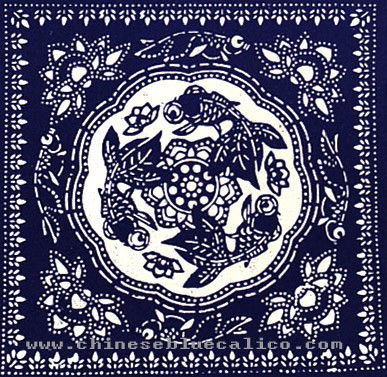
Chinese Blue Calico is the broad name covering four different kinds of dyeing skills. It includes painting, printing, tie dyeing, clamp-resist dyeing and batik dyeing.
1.Painting
Using a brush with pigment to apply an ornamental pattern on a textile, painting is the prototype of printing and dyeing. Many examples are found in Han to Liao textiles (2nd century BCE to 10th century CE).
2.Printing
Printing with carved blocks, included two methods. One was stamp printing with blocks, such as the textiles from Mawangdui, an archaeological site from the Han Dynasty (202 BCE - 220 CE), located in Changsha, China. A second method was stencil printing with plates , which was very popular in the Song dynasty (960 -1279 CE).
3.Tie dyeing
Tie dyeing (Jiaoxie or Zaran) is a method of resist dyeing. Before dyeing, a series of knots is made in the textile. When the cloth is dyed, the dye does not penetrate the knotted area. This method appeared in the 3rd to 4th centuries CE and is still used today.
4.Clamp-resist dyeing
Clamp-resist dyeing (Jiaxie , commonly known in English by the Japanese term kyokechi) uses two symmetrically carved blocks to clamp the folded textile. When dyed, the repeated pattern of the block is obtained. It is said that the sister of Liu Jieshu in the reign of Emperor Xuanzong (712-756 CE) in the Tang dynasty, invented this method. She was one of the imperial concubines of the Emperor Xuanzong. It was very popular in the Tang (618-906 CE) and Song dynasties (960-1279 CE) and was used for tanka/thang-ga (It is a traditional sort of Tibetan painting.) covers in the Ming (1368-1644 CE) and Qing dynasties (1644-1912 CE).
5.Batik dyeing
Batik dyeing (laxie), also known as wax-resist dyeing (laran), is a form of dyeing or printing folk art made by applying beeswax to create different shapes. The history of batik dyeing can be traced back to the Western Han Dynasty (206 BC-24 AD). It used to be popular in both central and southwest China. Somehow, the technique was lost in central China, but it has been handed down from generation to generation among the ethnic people in Guizhou province in southwest China.
|